| Slalom Racing
Explained...
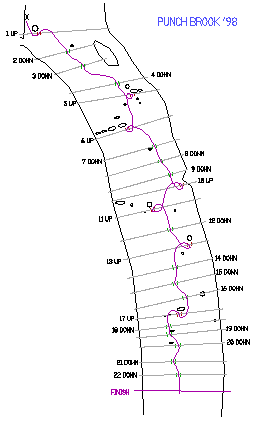
Whitewater slalom racing requires the paddler to negotiate a series of 20-25
gates in a section of whitewater, typically class 1-4 (easy to difficult).
The gates are hung just above the water - 6" minimum - so that a closed
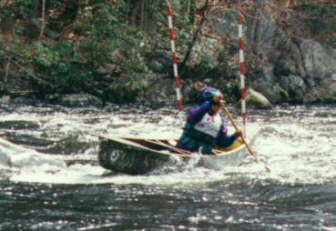
boat can sometimes sneak under the gate, but your body must pass between
them. Typically, open boats must keep their entire length under control,
although sometimes the gates are hung very high on a particularly awkward
move.
Some of the gates are negotiated with the main current, some are placed in
eddies and run "upstream." An ideal course is run something like it
would be if there were no gates, and the paddler is just playing the rapid,drunk girls porn
but some courses are pretty far from that ideal.
Scoring
Open boats: A 10 second penalty is added
for every gate you touch, a 50 second penalty for every gate the paddler
doesn't negotiate properly. Your total score is your running time plus
all the penalties. You are allowed two runs, and your best time is
the score. Running times now are in the 3-4 minute range. Finishing
"clean" - without touches is possible, but rare, so that accuracy is very
important. I have run clean in only a couple of open boat races. |
 |
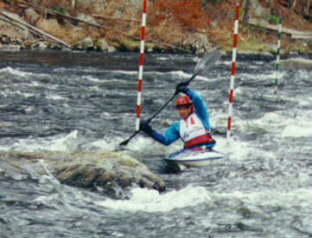
| Closed boats: You only get
a 2 second penalty for a touch, 50 seconds for missing a gate. Running
times are about 2-3 minutes. About 25% of paddlers have a clean run.
You have two runs, and your score is the total of the two
runs, unlike the open boats. There has been a trend toward
shorter courses over the years, encouraged by the governing body. Better
TV, I guess. |
 |
The classes:
Paddlers are ranked based on their previous race finishes, and the races
are rated for certain classes of paddlers. The ranking method is arcane
and complex, but the bottom line is that in a given class, approximately
10% are rated A, 20% B, 40% C and 30% D.
The races are theoretically designed around the paddler's competancy. A/B
races are on more difficult water and have much more difficult moves. C/D
races are rarely on water morefree coffee grinder difficult than class II whitewater. On
most C/D courses, I can paddle from the bottom of the course to the top!
On most A/B courses, if you pass by a gate, you probably won't be able
to recover.
 |
C/D races have separate classes for
practically any kind of boat and age group. At Punch Brook, we had
over twenty classes: Open, closed, solo, cruising boat, racing
boat, tandem, junior, senior, masters, all sex separated. Whew! |
| In A/B races there are only a few
classes separated by sex and type of boat (kayak, C-1, or C-2). Much
simpler to score anyway!
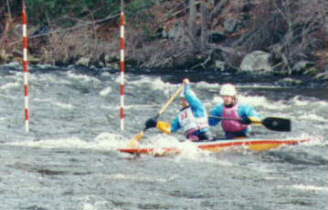
(This is a C-2 at the Punch Brook C/D Slalom ) |
 |
|